Classificação científicaScientific classification
| Reino:Kingdom: | Animalia |
| Filo:Phylum: | Chordata |
| Classe:Class: | Aves |
| Ordem:Order: | Psittaciformes |
| Família:Family: | PsittacidaeRafinesque, 1815 |
| Espécie:Species: | A. hyacinthinus |
| Nome científico:Scientific name: | Anodorhynchus hyacinthinus(Latham, 1790) |
| Nome em inglês:English name: | Hyacinth Macaw |
CaracterísticasCharacteristics
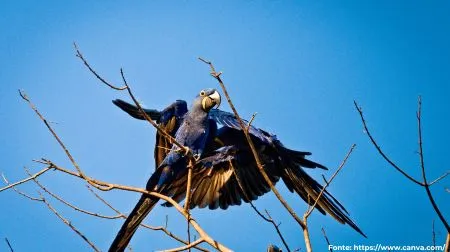
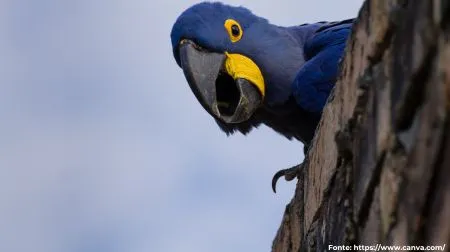
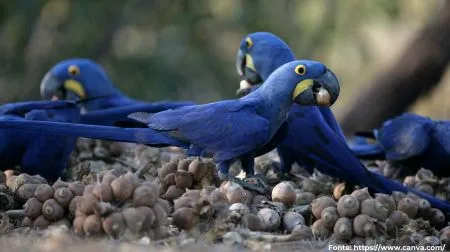
A arara-azul-grande (Anodorhynchus hyacinthinus) é a maior espécie de arara do mundo, podendo atingir cerca de 1 metro de comprimento, 1,40 metro de envergadura e pesar aproximadamente 2 kg. Sua plumagem azul intensa é inconfundível, apresentando diferentes tonalidades conforme a incidência da luz. O bico é grande, extremamente forte e preto, com uma faixa de pele amarela na base, além de um anel amarelo ao redor dos olhos. As partes internas das asas e da cauda são negras. Além da beleza impressionante, o poderoso bico permite quebrar os frutos mais duros das palmeiras, sua principal fonte de alimento.
The Hyacinth Macaw (Anodorhynchus hyacinthinus) is the largest macaw species in the world, reaching about 1 m (3.3 ft) in length, with a wingspan of up to 1.4 m (4.6 ft) and weighing around 2 kg (4.4 lb). Its brilliant cobalt-blue plumage is unmistakable, displaying different shades depending on the light. The massive black bill is exceptionally powerful and is highlighted by bright yellow bare skin at its base and around the eyes. The undersides of the wings and tail are black. Its remarkably strong bill enables it to crack the hard nuts of palm trees, which make up most of its diet.
AlimentaçãoFeeding
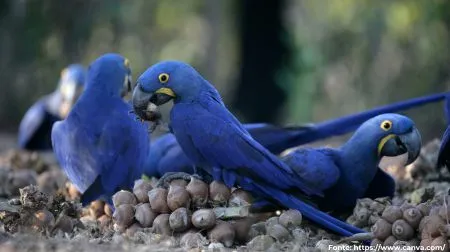
A alimentação da arara-azul é altamente especializada, sendo composta principalmente pelos frutos de diversas espécies de palmeiras. No Pantanal, suas principais fontes de alimento são os coquinhos do acuri e da bocaiúva, cujas sementes são quebradas com facilidade graças ao seu poderoso bico. Em outras regiões do Brasil, também consome frutos de babaçu, inajá, tucum, gueroba, piaçava, catolé e outras palmeiras nativas, desempenhando importante papel na dispersão de sementes.
The Hyacinth Macaw has a highly specialized diet based mainly on the nuts of native palm trees. In the Pantanal, it feeds primarily on the fruits of the acuri and bocaiúva palms, easily cracking their extremely hard shells with its powerful bill. In other regions of Brazil, it also feeds on the nuts of babaçu, inajá, tucum, gueroba, piaçava, catolé, and other native palms, playing an important role in seed dispersal.
ReproduçãoReproduction
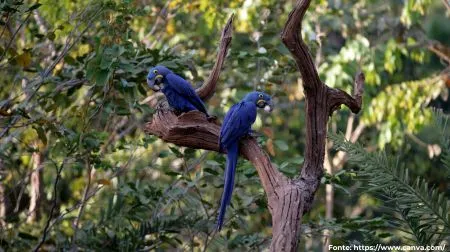
A arara-azul forma casais que permanecem juntos por toda a vida. Durante a reprodução, utiliza grandes cavidades naturais em árvores antigas, especialmente manduvis no Pantanal, além de ocos de palmeiras e cavidades em paredões rochosos em outras regiões do Brasil. A fêmea geralmente coloca um ou dois ovos, e o casal divide os cuidados com o ninho e os filhotes. Normalmente apenas um filhote sobrevive até a fase adulta, recebendo intensa dedicação dos pais durante vários meses.
Hyacinth Macaws form lifelong pairs. During the breeding season, they nest in large natural cavities in old trees—especially manduvi trees in the Pantanal—as well as in palm cavities and rock crevices in other parts of Brazil. The female usually lays one or two eggs, and both parents share the responsibility of caring for the nest and raising the chicks. In most cases, only one chick survives to adulthood, receiving parental care for several months.
HábitosHabits
No Pantanal, vive principalmente em áreas abertas com palmeiras, matas ciliares, cordilheiras e capões de mata, onde encontra alimento e locais adequados para nidificação. É uma ave extremamente sociável, sendo observada em casais, grupos familiares ou pequenos bandos. Seu voo é forte e elegante, acompanhado por vocalizações altas que podem ser ouvidas a grandes distâncias. A arara-azul passa boa parte do dia deslocando-se entre áreas de alimentação e dormitório, exercendo importante papel ecológico ao dispersar sementes de diversas espécies de palmeiras.
In the Pantanal, the Hyacinth Macaw inhabits open areas with palm trees, gallery forests, forest islands, and wooded ridges where it finds both food and suitable nesting sites. It is a highly social bird, commonly seen in pairs, family groups, or small flocks. Its powerful, graceful flight is accompanied by loud calls that carry over long distances. The species spends much of the day traveling between feeding and roosting areas and plays a vital ecological role by dispersing the seeds of many native palm species.
ReferênciasReferences
Collar, N.J. 1997. Family Psittacidae (Parrots). In: Del Hoyo, J., Elliot, A.E., Sargatal, J. (eds.).Handbook of the Birds of the World, vol.4, Lynx Edicións, Barcelona, Pp: 280-477. FOLHA DE SÃO PAULO, edição eletrônica de 24 de julho de 2010. Guedes, N.M.R. 1993. Biologia Reprodutiva da Arara Azul (Anodorhynchus hyacinthinus) no Pantanal-MS, Brasil. Dissertação de Mestrado. Universidade de São Paulo, Piracicaba. Mahecha, José Vicente Rodríguez; Suárez, Franklin Rojas; Arzuza, Diana Esther; Hernández, Andrés Gonzáles. Loros, Pericos & Guacamayas Neotropicales. Panamericana Formas e Impresos S.A., Bogota D.C., 2005, Pág. 51. Portal Brasil 500 Pássaros, Arara-azul-grande. Disponível em:http://webserver.eln.gov.br/Pass500/BIRDS/1birds/p105.htm. Acessado em: 06 mai. 2009 Presti, F.T., Oliveira-Marques, A.R, Silva, G.F., Miyaki, C.Y., Guedes, N.M. 2009. Notas sobre alguns aspectos da biologia da arara-azul (Anodorhynchus hyacinthinus) (Psittaciformes: Psittacidae) na região do Carajás, Pará. Atualidades Ornitológicas 151: 4 – 7. The encyclopedia of birds. International Masters Publishing, New York, 2007, Pág. 537. CLEMENTS, J. F.; The Clements Checklist of Birds of the World. Cornell: Cornell University Press, 2005. http://www.wikiaves.com.br. Acesso em: 13/12/2024