Classificação científicaScientific classification
| Reino:Kingdom: | Animalia |
| Filo:Phylum: | Chordata |
| Classe:Class: | Aves |
| Ordem:Order: | Falconiformes |
| Família:Family: | FalconidaeLesson, 1843 |
| Espécie:Species: | H. cachinnans |
| Nome científico:Scientific name: | Herpetotheres cachinnans(Linnaeus, 1758) |
| Nome em inglês:English name: | Laughing Falcon |
CaracterísticasCharacteristics
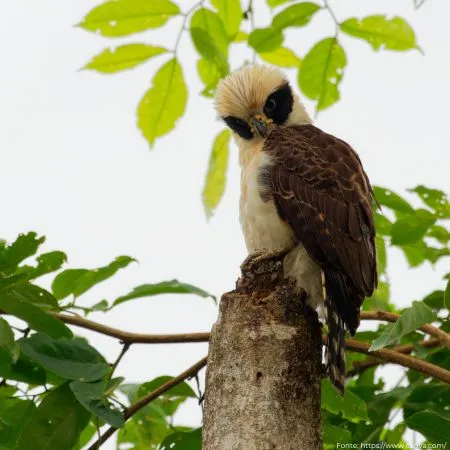
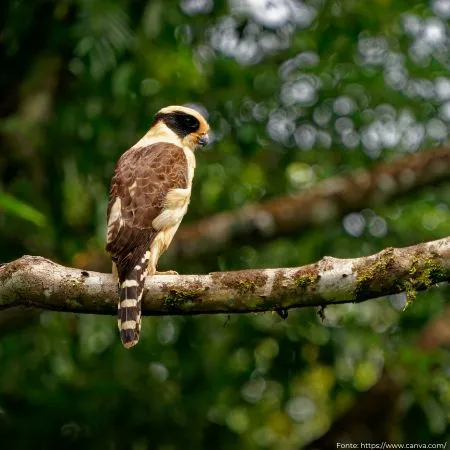
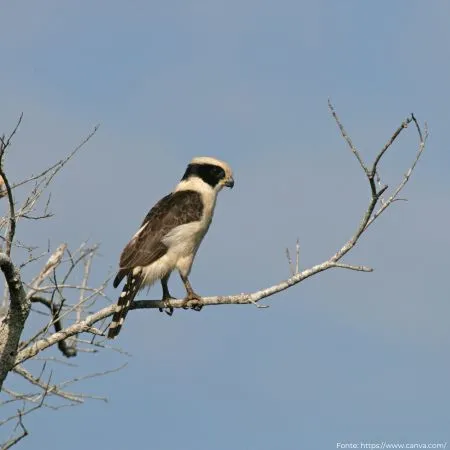
Esta ave de rapina mede entre 45 e 56 cm de comprimento, possui envergadura de 75 a 91 cm e apresenta grande porte, com machos pesando entre 544 e 675 g e fêmeas entre 590 e 800 g. Sua característica mais marcante é a ampla máscara negra que cobre a região dos olhos e se estende até a nuca. A cabeça possui coroa branca com finas estrias escuras e uma pequena crista na parte posterior. O dorso, as asas e a cauda são marrom-escuros, enquanto a garganta, o peito e o ventre são predominantemente brancos, com leve tonalidade amarelada. A cauda é longa, apresenta uma faixa branca na extremidade e várias barras claras. O bico é curto, curvado e preto, adaptado para capturar presas. As pernas amarelo-claras são fortes, equipadas com garras negras e afiadas, características típicas das aves de rapina.
This bird of prey measures 45 to 56 cm (18–22 in) in length, has a wingspan of 75 to 91 cm (30–36 in), and is medium to large in size. Males weigh 544–675 g, while females are generally larger, weighing 590–800 g. Its most distinctive feature is the broad black facial mask that extends from the base of the bill to the back of the head. The crown is white with fine dark streaks and a small crest at the rear. The back, wings, and tail are dark brown, while the throat, chest, and underparts are mostly white with a slight yellowish tint. Its long tail displays a white tip and several pale bands. The short, hooked black bill is well adapted for capturing prey, and its strong pale-yellow legs are equipped with sharp black talons, typical of birds of prey.
AlimentaçãoFeeding
Alimenta-se principalmente de serpentes, sendo conhecida por sua habilidade em capturá-las, embora a maior parte de suas presas seja formada por espécies não peçonhentas, como a cobra-cipó. Também caça pequenos mamíferos, lagartos, outros répteis e pode consumir carrapatos e outros parasitas encontrados sobre o gado.
Its diet consists mainly of snakes, for which it is especially well known, although most of the species it captures are non-venomous, such as vine snakes. It also feeds on small mammals, lizards, other reptiles, and may remove ticks and other parasites from cattle.
ReproduçãoReproduction
Costuma construir seu ninho em cavidades naturais de árvores de grande porte. Em algumas ocasiões, também reutiliza ninhos abandonados de outras aves de rapina para realizar a postura e criar seus filhotes.
It usually nests in natural tree cavities, especially in large mature trees. Occasionally, it also reuses abandoned nests built by other birds of prey to raise its young.
HábitosHabits
Habita bordas de florestas, matas ciliares, áreas em regeneração, cerrados e campos com árvores esparsas. Vive geralmente de forma solitária, permanecendo por longos períodos empoleirada em árvores isoladas ou galhos secos, de onde observa atentamente o ambiente em busca de alimento. É mais ativa durante o início da manhã e o final da tarde, quando também costuma vocalizar. Seu comportamento paciente e sua excelente visão fazem dela uma caçadora extremamente eficiente.
It inhabits forest edges, gallery forests, regenerating woodlands, savannas, and open fields with scattered trees. Usually solitary, it spends long periods perched on isolated trees or dead branches, scanning the surroundings for prey. It is most active during the early morning and late afternoon, when it is also more vocal. Its patient hunting strategy and excellent eyesight make it a highly efficient predator.
ReferênciasReferences
Bierregaard, R.O., Jr & Kirwan, G.M. (2016). Laughing Falcon (Herpetotheres cachinnans). In: del Hoyo, J., Elliott, A., Sargatal, J., Christie, D.A. & de Juana, E. (eds.). Handbook of the Birds of the World Alive. Lynx Edicions, Barcelona. Dunning, J.B., Jr. 2008. CRC handbook of avian body masses. Second edition. CRC Press, Boca Raton, Florida. Hilty, S.L. 2003. Birds of Venezuela. Second edition. Princeton University Press, Princeton, New Jersey. Howell, S.N.G., e Webb, S. 1995. A guide to the birds of Mexico and northern Central America. Oxford University Press, New York, New York. Portal Brasil 500 Pássaros, Acauã. Disponível em: http://webserver.eln.gov.br/Pass500/BIRDS/1birds/p55.htm. Acessado em: 05 mai. 2009. WikiAves (##2024##) WikiAves, a Enciclopédia das Aves do Brasil. Disponível em: https://www.wikiaves.com.br/wiki/acaua. Acesso em 16/12/2024.